Postmodernism

Postmodernism
Seeing is not always believing and believing is more than seeing

Monday, July 22, 2013

DISCLAIMER!


 * DISCLAIMER *

The views and opinions expressed in this blog are not necessarily the views of Julian Tyler.

Views and Opinions of Julian Tyler are subject to change without notice.

This blog is intended to serve only as amusement, is not intended to cure any illness and nothing that you read in this 'Postmodernism Blog' should be regarded as medical, mental or health advice. None of the statements on 'Postmodernism' are suppose to be understood as a recommendation as to how to treat any particular disease or [mental] health related condition.  If you are struggling with critical theory and require medical, psychological, existential, linguistic, artistic, multidimensional or other assistance, you should consult a [Postmodern] professional!

"Are you not entertained?!"


Social Media

I work in the media business.

Social Media is becoming increasingly important to 'traditional media'.  It's important to have a coherent social media strategy.

Twitter is great for broadcasting.  Tweet it and it goes out to everything, including Facebook.

Facebook is where you can group and compartmentalize, layer and develope platforms, like games.

Instagram is good for photography, and capturing moments.  I try to add pictures as often as I can.  All pictures taken by me!   I post some Insta-pics on my Facebook, for my Facebook friends and can allow them to be seen by all or only certain groups.  If I want to share a picture with everyone I post it from Instagram to Twitter, and Twitter posts it to Facebook as "public".

Fan Pages are for your true fans.  These are the people you want to engage most with.  They want to hear about you and your projects.  Your "fans" are the ones who want the free gifts, and will be waiting in line to buy your book or see your movie.  This is where you want to show love and give them certain insights you don't give others.

It's about curating content for your given audience.

You want a little redundancy in your social networks.  But you you don't want uniformity, at least that is my opinion.  If you give everything, say on Facebook, then your friend/fan/follower may not be inclined to follow you elsewhere, like to your Fan Page or Instagram, and it will not expand your social network.  Give some content from other platforms, but not all.

Not everyone wants to read or see everything.  You want the people that want more of your content to get more, and those that only want some to get only what they want.  Ideally you want people to want more content and access.

It's all about the content.


Monday, July 8, 2013

Beauty is Truth


"Beauty is truth, truth beauty"

I saw this on the wall in the Library of Congress, and just remembered to look it up.

It's from "Ode on a Grecian Urn"
by John Keats (1820)

http://en.wikipedia.org/wiki/Ode_on_a_Grecian_Urn

The whole poem is on the Wikipedia page, here are the last five lines:

When old age shall this generation waste,
Thou shalt remain, in midst of other woe
Than ours, a friend to man, to whom thou sayst,
"Beauty is truth, truth beauty," – that is all
Ye know on earth, and all ye need to know.

I thought I'd share it.  I liked it.

John Keats' ode to a treasure of Classical Antiquity immortalized him, much like the creation of the Art by which the poem was inspired immortalized the Artist.  The essence of the poem, that beauty is eternal as truth is eternal is moving, and resonated with me.  Obviously it resonated strongly with the builders of America's greatest, and one of the worlds greatest libraries.

The profound beauty and art of the ancient world still reverberates to the present, passing through time unchanged in truth and beauty.

The truth is beautiful.

Beauty is truth.

It's beautiful because it's true.


Sunday, July 7, 2013

Silicon Beach


Silicon Beach Fest

“What is Silicon Beach?”

I asked this question when I attended the annual Silicon Beach Festival in Santa Monica.  This year is the second year of the festival, 2012 was the first.  While the idea of ‘Silicon Beach’ has received notable press over the last year, since the first year of the festival, the question of what exactly ‘Silicon Beach’ is remains for many, including myself.
            The name ‘Silicon Beach’ is derived from the concept of Silicon Valley.  The banner of ‘Silicon Beach’ implies it is a branch of, or related to, Silicon Valley.   This begs the question:

“What is Silicon Valley?” 

Silicon Valley is the southern region of the San Francisco Bay Area in Northern California, in the United States. The region, whose name derives from the Santa Clara Valley in which it is centered, is home to many of the world's largest technology corporations as well as thousands of small startups. The term originally referred to the region's large number of silicon chip innovators and manufacturers, but eventually came to refer to all the high-tech businesses in the area, and is now generally used as a metonym for the American high-tech sector.”   -- Wikipedia

Silicon Beach can therefore be the name / metonym given to the tech/startup community of Los Angeles County.  
Some people don’t think the name ‘Silicon Beach’ makes sense because you won’t find the production of Silicon chips which gave Silicon Valley its namesake.  While other names have been thrown around, like ‘LA Tech’, for me the name ‘Silicon Beach’ is fitting.  Unlike other burgeoning tech communities, as in New York, Austin or London, Silicon Beach actually has close connections to Silicon Valley, and increasingly has the direct investment of Silicon Valley companies like Google, and connections to Pixar (Disney) via Apple computer. 
The idea of a “Silicon Valley of the South”, a tech industry like Silicon Valley in Los Angeles County is easy to get behind for LA locals and the state.  Who in California wouldn’t want a tech boom in Los Angeles County?  Not many Californians (and fewer Southern Californians) are against more good jobs, more economic growth and more wealth in the local economy.  The idea of a ‘Silicon Valley of the South’ would imply just that.  The feeling that ‘Silicon Beach’ has the potential to be a “Silicon Valley of the South” is palpable. 
The energy of the festival and the LA Tech community is that of a startup, an idea with the essential elements of a good startup: value and story.  The Los Angeles community of tech interests appear to be getting behind and investing in the idea, which makes it prime to take off in a big way.  Is it possible for ‘Silicon Beach’ to become something like ‘Silicon Valley’?  “Anything is possible” and “think big” was the mantra the echoing throughout the four-day festival.  
What most sets Silicon Beach apart from its tech industry sister in the North is fact that Silicon Beach is more entertainment/content/media and creatively focused, less about hardware and an algorithms.  If the Festival schedule is any indication, Silicon Beach is decidedly focused on entertainment, with topics like Hollywood, social media, gaming and content distribution the subject of many panels.  The historic focus of Los Angeles on entertainment is a benefit to Silicon Beach, as the creative community of Hollywood and the associated creative industries (gaming, advertising, fashion) has the effect of making the Southern California tech scene that much more unique, and maybe even gives it a creative edge.
Los Angeles County has long been home to technology related industries like Aerospace, so Silicon Beach has a local base of skilled computer and engineering talent to draw from.  Only a few miles down the beach south from Santa Monica and the Silicon Beach Festival is a the city of El Segundo, which has Raytheon, Lockheed Martin, Northrop Grumman, and Xerox among it’s top employers.  Also within the county are several world renowned science and technology research universities, CalTech, USC and UCLA.  CalTech made an appearance at the festival and displayed some of it’s 3-D printing technology; very cool I might add.  USC recently completed state-of-the-art facilities for film production, virtual reality and gaming on its campus, and operates the Institute for Creative Technologies in Playa Vista.  UCLA is also an incubator of talent for startups, and was involved in the creation of the internet as we know it.  Throw in Idealabs and the Pasadena tech scene which was present at the festival and all of this is like water on the seeds of potential in the garden of Silicon Beach.
With the growing dependence, focus, and investment by Hollywood in technology (3-D, visual effects, digital distribution) and social media (for advertising, metrics, distribution), the presence of tech startups all over the county already, and skilled and motivated human resources nearby, the stage for a new hub of tech startups is set and lit.  Google (as well as others) are also building/operating facilities (Google’s YouTube Studios in Playa Vista is a perfect example) in Los Angeles to follow the trend of Silicon Valley integration with Hollywood.  Digital LA and the founders of Silicon Beach Fest are definitely on to something

So what is Silicon Beach?

Silicon Beach is the triumvirate of Los Angeles based Technology resources/talent, Global Media Conglomerates, and Creative artists (content creators).  Silicon Beach is the love-child of Silicon Valley and Hollywood.  It’s a banner and metonym under which Los Angeles County startups and tech scene can form a community to learn and grow together. 

Silicon Beach is a startup.

"If you are successful in your startup what does that look like?"  "What is the heart and soul of your business idea?"  -- Matt McCall, New World Ventures

If the Silicon Beach “startup” is successful, the Los Angeles tech and creative communities have a new incubator of innovation, a way to attract talent and new business, and economic growth.  The ‘heart and soul’ of the idea is to form a community of innovators with common goals and interests to promote and grow the community, and its interests.

The Silicon Beach Festival is a great way to meet the LA Tech community!

The opening party at Viceroy in Santa Monica started out small, but quickly grew to a packed house.  For the first day I wasn’t able to view the website for the Festival schedule because, as I was told, the site was overwhelmed with traffic and crashed -- too much of a good thing I guess.
The Festival, much like the Silicon Beach community itself, is fractured and decentralized.  The panels took place mostly in two locations ROC and Cross Campus in Santa Monica, and at these locations there were usually three compartmentalized ‘tracks’ of panels going on in the building.  At any given time during the festival there were always at least six (sometimes more) panels or events all happening at once.  Hollywood, Gaming, Startups, Advertising, Social Media, and other topics were topics being discussed in different rooms or as part of certain tracks.  This is reflective of Silicon Beach, which itself comprised of many different elements.  However it makes for difficult choices for someone like myself who wishes they cold be in two places at once.
This can be frustrating at times because there is no way you can see it all.  I recommend planning what panels or tracks are most interesting to you ahead of time.  Ideally the entire festival could take place in one location to make floating from discussion to discussion easier, but most people have a ‘track’ that is their focus, so the structure is workable.
There was so much to see and do it was almost overwhelming.  Hackathons, Lunches, Parties, Fashion shows, demos, and after parties.  I recommend trying to get in as much as possible, but not spreading yourself too thin.  Don’t try and see everything and end up not really getting into the meat of anything.  For me, it’s also important to not be too rigid, sometimes it’s nice to go sit in on something I know nothing about, talk to people and see what they are doing, and be open to exploring other topics you thought you didn’t have interest in.  You may have more interest and connection to the topic/discussion than you thought, and it may have more connection to your goals than you realize.
If you love technology and or entertainment, and have interest in startups and innovation, as I do, you would definitely enjoy this festival.  Even if you aren’t really into technology, but you create content, or work in Hollywood, gaming or advertising you will likely enjoy the festival.  Anyone that loves a party will enjoy the parties.
I look forward to next years’ festival, and have a feeling it’s only going to get bigger and better in the years ahead.


Tuesday, June 4, 2013

Postmodern Muse

Muse is a great word.  It means to think to one's self as a verb, and as a noun it means a goddess who provides over Arts and Sciences.


muse |myoōz|verb [ intrans. ]be absorbed in thought he was musing on the problems he faced.• [with direct speech say to oneself in a thoughtful manner “I think I've seen him somewhere before,” mused Rachel.• ( muse on) gaze thoughtfully at.

Muse |myoōz|noun(in Greek and Roman mythology) each of nine goddesses, the daughters of Zeus and Mnemosyne, who preside over the arts and sciences.• ( muse) a woman, or a force personified as a woman, who is the source of inspiration for a creative artist.

Postmodern Muse |pōstˈmädərˌnizəm||myoōz|
noun

A man or woman who is unbaisedly considered good at:

• Providing the best advice and council for friends, family, fans and fellow dreamers and creative thinkers.

•  Being able to talk about Art & Science and Philosophy and Metaphysics as well as Beauty and the nature of how it affects us, in the moment, in the past and in the future; i.e. 'wax poetic' with great intellect and intertextual contextual retrospect.

• Words!  Be great with words, and best in person.  Witty.  Fun.  Humorous. Interesting and Informative.

•  Helping people see what they want, visualize and imagine, and figure out how to get it, make it, or do it, or create it.

• Listening, Visualizing and conversating effortlessly and fluidly from topic to topic, exploring topics, possibilities or options, brain storming, making connections, mind opening.*  (*is essential for the Postmodern muse.)

• Finding the truth in every situation, and working from there to strategize, problem-solve, or resolve the situation, or make a creative breakthrough; and better the future.

• Amusing.  A Postmodern Muse is always amusing.

Wednesday, April 10, 2013

The Future of Screenwriting


The Future of Screenwriting, a dialogue with quotes from a Producer.

“Routine interest movies will die.”

No kind of movie will die. A silent film won an Oscar only a year or so ago. There will always be a market for everything. Whether it's YouTube channels or indie theaters. If anything the fracturing of the market, the compartmentalizing of media markets and types helps people find what they want and buy more of it. If it's not commercially viable on a global scale, it can be scaled down for a specific market or platform, and for instance be used to generate ad revenue on your YouTube channel.


“Theatrical movies will become almost exclusively franchise, brand, and thereby commerce driven.”

I think it's fair to say +$100 million dollar films will (or already have) become largely franchise, established IP, or brand driven. But there will always be that amazing spec script that someone finds and is able to raise capital to make, and a major distributor is willing to market and sell. That will never go away.

No one really knows the future, but my opinion is that the way studio's are building their slates now, is most likely how it will be for a while.

There will always be the franchise/brand pics in summer, the prestige Oscar pics like "Argo" or "Silver Linings Playbook", and the indie that gets global distribution.


“The concept of the movie star will continue to mean less and less until we don't have any left.”

I think the opposite of this actually the truth. Movie stars have seen themselves become increasing more in demand globally and more powerful than ever. Having millions of Twitter followers is powerful and meaningful. Investing in tech start-ups, getting into politics, movie stars are more powerful and (world stage) prominent than ever.

The concept of the movie star is also integral the the Hollywood machine. Hollywood loves movie/media stars, loves to make them, hate them, and use them to sell products, magazines and movies. I don't see the movie star ever going away or diminishing at all.


“The next evolution of TV (i.e. Netflix Original Programming) will drive the next wave of artistic integrity and push our industry forward.”

 I think the HBO and Netflix model is pushing the industry forward in many ways. Because the subscription model isn't ratings or advertising driven it allows for the creation of content that is able to take creative risks and pursue "artistic integrity". But there are many different forms of artistic integrity, 3-D for example, that are also pushing the industry forward. The attractiveness of TV is greatly increased by the proliferation of mobile devices, platforms and digital distribution, which create more ways to generate income from content over the long haul, which allow for more risk. But I would not write off films and do not believe that theatrical films cannot also benefit from the expansion of ways to consume content. I also see the trend of TV to movies and movies to TV shows as only just beginning to catch on, which allows for TV and movies to drive each other forward creatively and financially.

If you believe that "nobody know anything" then it is possible that the people that claim "nobody knows anything" are incorrect or know nothing, and therefore somebody does know something. I believe that corporations/studios are inclined to believe that even their executives don't know enough to bank on, which is why the big media corporations are turning to computers, metrics, algorithms and 'big data' to tell them something/anything. What the data can tell them is that the market for a film/TV/media project is worth a certain amount and the investment should be tailored accordingly. Computers help corporations mitigate risk and identify markets in a way no person can, which in the long run will actually help Hollywood make more profits and spend money more wisely, making it possible to take more creative risks because they are on stronger financial footing.

A computer can't tell you if a movie is good or bad, but it can certainly tell you which demographics are responding to it, and if further development/investment is worth while. Gone are the days of $100 million dollar investments based on what a few people think will sell. Studios want more assurances than that in the climate of Hollywood today, because maybe those people greenlighting the spending of $100 million on a film don't know anything. As I see it, the creation of high quality content will always be a sound investment, because IP can generate income for decades, and can be leveraged to get more money from transmission fees or pay subscription services. Think of how AMC used 'Mad Men' to negotiate higher retransmission fees because satellite and cable companies know they have to pay it in order to not upset the millions who watch the show, and would be furious if the channel was dropped from the service.

This brings it back to Netflix/HBO which can spend $100 million on something that may be a risk, but that helps them build their brand, and keep exclusive content behind their pay wall that will help them retain subscribers, and keep the money coming in.

It's an exciting time to be a writer, but writers need to be more versatile, more creative, and more business and tech savvy to compete in the global media market that is Hollywood -- or at least have a team that helps you compete. To succeed you need to find that balance of Art and Business; or "artistic integrity" and commercial viability. There is less easy money floating around post 2008, but more opportunity than ever for creative entrepreneurs in the digital age.

Tuesday, March 12, 2013

Public Art: Bay Bridge Lights

The genius of the Bay Bridge Lights as a public Art piece is that it can be turned on, adding art/form to art/function, or off and gone.

It's generally not possible to turn off an art piece and have it be virtually unnoticeable.

Some people criticize the Bay Bridge Lights. I equate those people to the Parisians who hated the Eiffel Tower when it was first built.

Short sited. Critical without foresight.

The lights don't turn the bridge into a shadow. They add 21st century beauty and elegance to 20th century beauty and elegance that is often hidden in shadow or fog. The lights bring attention to the function and form Art can take, and the ways which technology effects us. Art and technology can build us bridges to cut travel times or light spaces to take us to places we never knew we could go. The lights helps us see the beauty of the bridge, and the simple fantastic production value of an algorithm and highly efficient light bulbs.

I'm a big fan of the lights and think the should be made permanent.

Friday, October 12, 2012

"Film Biz Feng Shui"


Fung shui, is a Chinese system of geomancy believed to use the laws of both Heaven (Chinese astronomy) and Earth to help one improve life by receiving positive qi.[3]  -- Wikipedia

"Film Biz Feng Shui"

It's an all American system of catalyzing ideas (scripts, books, dreams) believed to use the laws of both the real world and the bizarro world, to improve the end product and receiving of positive cash flow or true world of art (ideally both).

I pride myself on being a master of it.

It's all about the little things, like setting up office furniture in just the right way, for ideal business flow.  Or a well placed plant or well timed surprise treat can pay for it's self many times over in productivity. It's about understanding the mix of personalities and how they are working or not working.  It's about connecting all the little things, the rain drops into the big things, the river, aligning your project with the right people, and with the larger patterns and movements of the Hollywood Stars and the Hollywood system as a whole.

I know how make a flow, go with the flow, and eventually guide the flow.

Film making is a very collaborative process, it takes bringing together of many different "elements" and people.  To make a feature film you need (sometimes crazy) creative Artists, unpredictable crew members, accountants, non-creative or "money" people, IP lawyers, and more...   You will need to know how to mix and blend these elements in just the right way.  It's a lot harder than it seems.  If you didn't know the proportions of the ingredients of a cake, your cake would not be edible most likely.  Sometimes, if you mix "elements" (people, energy) in the wrong way, it'll blow up in your face.  With the right FBFS, you can make a film production flow almost effortlessly... and save millions.  You can have your cake and eat it too.

It's why I know I will be a great Producer or Production consultant one day.

It's all about Film Biz Feng Shui.


Sunday, September 30, 2012

Areté

Make Art with arete.

Be an Artist with areté.  

Just by saying areté you will have it.

Arete (Ancient Greekἀρετή), in its basic sense, means excellence of any kind. In its earliest appearance in Greek, this notion of excellence was ultimately bound up with the notion of the fulfillment of purpose or function: the act of living up to one's full potential.

Areté is explicitly linked with human knowledge, where the expressions "virtue is knowledge" and "Areté is knowledge" are used interchangeably. The highest human potential is knowledge and all other human abilities are derived from this central capacity. If Areté is knowledge and study, the highest human knowledge is knowledge about knowledge itself; in this light, the theoretical study of human knowledge, which Aristotle called "contemplation," is the highest human ability and happiness." -Richard Hooker  *** thanks Wikipedia ****

And from Areté we get Art.  Art in the purest essence of the word, in every expression.


Wednesday, July 11, 2012

Equity


"For every wrong there is a remedy"

In Latin, "Ubi jus ibi remedium" ("where there is a right, there must be a remedy").  It's a maxim of law >> Equity will not suffer a wrong to be without a remedy.

"The maxims of equity evolved in Latin, and eventually translated into English, as the principles applied by courts of equity in deciding cases before them."

"Equity is commonly said to "mitigate the rigor of common law", allowing courts to use their discretion and apply justice in accordance with natural law."

"Natural law, or the law of nature (Latin: lex naturalis), is a system of law that is purportedly determined by nature, and thus universal.  Classically, natural law refers to the use of reason to analyze human nature -- both social and personal -- and deduce binding rules of moral behavior."

The Aristotelian approach to practical reasoning is based on the notion of a virtue, and generally avoids the separation of 'moral' considerations from other practical considerations.

Morality thus came out of the very idea (the essence) of civilization itself.  Aristotle tutored Alexander the Great, who used these principles, morality, ethics, logic, to create law -- EQUITY -- and a civilization we call "Western Civilization".  The civilization Alexander (and his wise men) created was the basis of the empires of Greece and Rome, which Europe and English are derived from, and which the American Republic was built on.

Laws are there to assure that those without morality are punished, wrongs are set right, so society/civilization can prosper.

Monday, June 4, 2012

Disruptive Innovation = Postmodernism


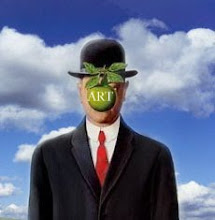
A friend of mine told me she wanted to find and read an article in the New Yorker.  It was the May edition, last month, so it might be hard to find a hard copy.  She Googled it, and showed me the cover.  It was a play of Magritte's surrealist faceless businessman.  I was instantly interested. Surrealist imagery and style that resonates very strongly with me, as you can tell by my avatar.  I quickly noted, "We don't need to find a hard copy.  I'm can just download it onto the iPad."


There's an app for that...

I was told the article was about "disruptive innovation", which of course also immediately sparked my interest.  First the cover I loved, and now an intellectually titillating subject like "disruptive innovation" for the article?   Disruptive innovation strikes right to the core of my two great passions, Science and Art.  I wanted to find and read the article as well.  My attention had been captured.

The article was:  "When Giants Fail:  What Business has Learned from Clayton Christensen"

Remind me to look into his books.  His ideas about the steel mill still hold value in the theory they construct, but "disruptions" are far more complicated now than the steel mill analogy can define.  I think of it as derivatives being a disruption on Wall Street... the steel mill analogy helps get the idea across, like the Bohr model of the atom, but it's only where you start your understanding, it does not account for the quantum mechanics involved and is thus difficult to produce answers from, directly.

The article was nice profile of him.  Christensen is a very interesting person, with a very good story and observation.  It got me thinking.  First, "disruption" is always relative to the disrupted.  Not everyone is disrupted, by every disruption, in fact sometimes people are better off from disruption, it is only the bottom line that is not.  Sometimes the bottom line is far better off with the disruption, it is the consumer, their health, or another specific industry that is disrupted -- starved to death and obliterated.  Manufactured food is disruptive to organic farming.  Rome was disruptive to Hellenism.  Modernism -- most explicitly in architecture, but also intellectually -- was disruptive to everything that came before it.  But...

Postmodernism is "disruptive innovation".  Postmodernism is disruptive innovation on Modernism.  It's sound onto the silent film biz, 3-D on Blockbuster filmmaking.  Postmodernism is that slight mutation of an idea or form that triggers a dramatic shift in the environment in which it operates.  When I think of disruptive innovation, I think of "Reality TV" -- disruptive innovation on traditional scripted programing.  It's an inferior technology overtaking a better one by numbers or force; market force.  It's what the invention of mp3s did to the Record Industry.  Napster brought an industry, that was over 100 years old, to it's knees in about one year's time.  Disruptions come fast and strong in Postmodernism.  Like hurricanes out of the clear blue sky, "disruptions" sweep in and the operating landscape is changed.  Facebook disrupted Myspace to death, but only distracted Google and Apple into paying attention.  Apple disrupted music, movies, books, cell-phones, computers... Silicon Valley is disrupting Hollywood, but also helping it...

Digital media is disrupting publishing, but it is also helping it.  This is when I realized to point of the article, and the idea.  Creating (your own) disruptions, ones that can help (you), is the name of the game.  Disruption can be a good thing, it doesn't have to be a bad thing, so long as you know how to use it.

***

I've been a fan of the New Yorker for a long time.  It's important to support good writers and organizations that nurture them.  "Buy writing content", I thought to myself.  Support the digital publishing model!  So, I downloaded the app and bought the magazine.  I wanted it enough to buy it, rare for me.  No need to call or drive around looking for it.  Instant readability at a nominal fee, really helped me.  

"What an age this is..."


Saturday, August 13, 2011

The PHARAOH effect

The PHARAOH effect...

People learn about the story, and it interests them.

They want to know more.

Secrets, mystery, myth, legend and science... it all resonates with people.

PHARAOH has something for everyone.

Comic-book and 'superhero appeal for kids.

Religious and intellectual depth for adults.

Fast, fun and spectacular action sequences for teens.

Hollywood needs films that can tap the growing global markets.

Films that transcend cultures, and appeal to everyone on a human level.

Hollywood needs films that can really explore the potential of 3-D technology, and push it to the edge.

PHARAOH is a multi-dimesional story, that draws you in, making it perfect to explore the potential of 3-D

Sequences of dreams, where characters fall through space and time. Like a worm-hole in 3-D

Action sequences where characters are in Virtual worlds (like the Matrix) where they 'manifest' weapons and battle robot and machines.

Exploring the mind, and dreams gives it the feel of 'Inception' by Chris Nolan, but with an esoteric twist and a 3-D edge.

PHARAOH has something for everyone, and the story is so universal it penetrates the mind like a catchy-toon...

It tickles the brain, and stirs the heart. It keeps the neurons humming with wonder.

The script PHARAOH makes you think, in a fun, stimulating way...

The movie it would leave you wanting more, wanting to see it again.

It's the PHARAOH effect.

It just feels right.

Monday, August 1, 2011

Guerilla Marketing

I had some pretty "big" screenwriters offer me feedback on my script (on a screenplay forum), for which I am grateful and humbled. Not all of them liked my style, or liked me -- so they said -- but they all seemed to agree the premise of PHARAOH is solid.

They all read a script part I posted. Which is all I wanted. Some read it with the intention of trying to bring me down, or to try and make my writing look bad, but all that really matters is that they read it! They were interested enough to read it, which is what's important.

I'm not some major Hollywood insider or writer, but everyone has to start somewhere, right?

What makes me happy is that I was able to hold my own with some top screenwriters in Hollywood, and that they now know who I am. I love that they read my script, and that had interest in me. What more can you ask for?

I know my methods are unorthodox -- or unknown to some -- and sometimes I get people riled up, or upset with my *postmodern* guerilla marketing strategies, but just remember one thing:

It worked! Lot's of people -- several Pro Hollywood screenwriters -- read my script PHARAOH!

"People that like Howard Stern listen for 1 hour. People that hate Howard Stern listen for 3 hours" -- as the saying goes.

I didn't hurt anyone, or insult anyone in my marketing, as some people did me. I didn't ask or tell anyone to read it. All I did was tell people about my script, put myself and my thoughts about it out there. People could take it or leave it.

Lots of people took it, and partook. That's all that matters. Even if they say they hated it. What matters to me is that they read it. That they were interested, and that it's in their head now...

It's like selling a house. I had an open house -- open script! -- and lots of people came and looked. That's what you want! You want lots of people to come and look. Even if they aren't in the market. It's the buzz that's important! If you have an open house and tons of people roll through, that's a good thing!! That means your marketing is working!

I put my 'PHARAOH' algorithm into the Hollywood/Screenwriters 'consciousness network' and after I did, it took on a life of it's own. I quickly realized the script is far FAR bigger than me, and it's going to take someone really big to helm it.

PHARAOH is so big -- story wise, 3-D production wise -- only someone big like Chris Nolan, or James Cameron can get it made. Only someone big can do a really big story justice.

Therein lies the problem for me, because it's really hard to get someone like them interested in a script from a 'baby-writer' like me -- since they can have any script they want. I have to show them why they want PHARAOH.

All I can do hope my "ethereal algorithms" do what they are written to do. If they don't, I'll just write more, until one does!

If you are wondering how do you get people to read your script...

Be creative! Whatever works! Just be yourself and have fun!

That's what I did. That's what it's all about.

For an (unsold) writer like me, you need to get people to read your stuff. That's the only way to get someone interested in you, and wanting to buy your work. No one will buy a house/script they (or someone they trust) don't see/read. Getting people to read it and give you feedback will help/make you grow and learn. That's what I want to to do, grow and learn.

I know my script isn't perfect -- no script is -- and my formatting is avant-garde. I don't expect it to meet the wildly varied expectations of everyone, or every "Pro" or that reads it. What script could?

How many "Pros" scripts could do that? Not many.

How many of the scripts that sell every year could do that? Even fewer.

I'm not saying PHARAOH did/does, all I'm saying is let's be realistic about our expectations. Some people will tell you: "It has to be perfect or it will never sell!" -- even though they know this to be false.

Good scripts can make bad movies, and bad scripts can make good movies. There is plenty of room for excellence if the underlying story is solid, and the talent attached sees the vision.

The "bones" of PHARAOH are solid. The story is profound. The concept has universal appeal.

It just has to work. The vast majority of the movie going public just want a good story. They just want to be entertained!

And entertaining people is what I do best!

I'm obviously not the best screenwriter to enter Hollywood. I'm just getting started, after all. But at least I'm here, putting stuff out there, ready to learn, and willing to engage. Hopefully entertaining! I keep it civil and don't insult people or go around trying to tear people down. That's not my style. I want to learn, and I want to help people... or at least have fun trying!

Playing (postmodern) games, and changing/challenging perspectives, making people look at thing differently is my style. Sure I can be defensive sometimes, but that's all part of the game/fun.

If you don't think it's fun, don't play! No need to get defensive about it!

I never play anyone for a fool, and I never assumed anyone is a fool. I don't think anyone should do so with me either.

I assure you, I'm no fool. I'm simply inventing/exploring was to play the Hollywood game, which is what it's all about.